





News
Search All News
Wednesday, October 7, 2026
Office Hours
Monday - Friday 9am - 5pmClosed Sat. and Sun.
Lehman Connections to Nobel-Winning Research
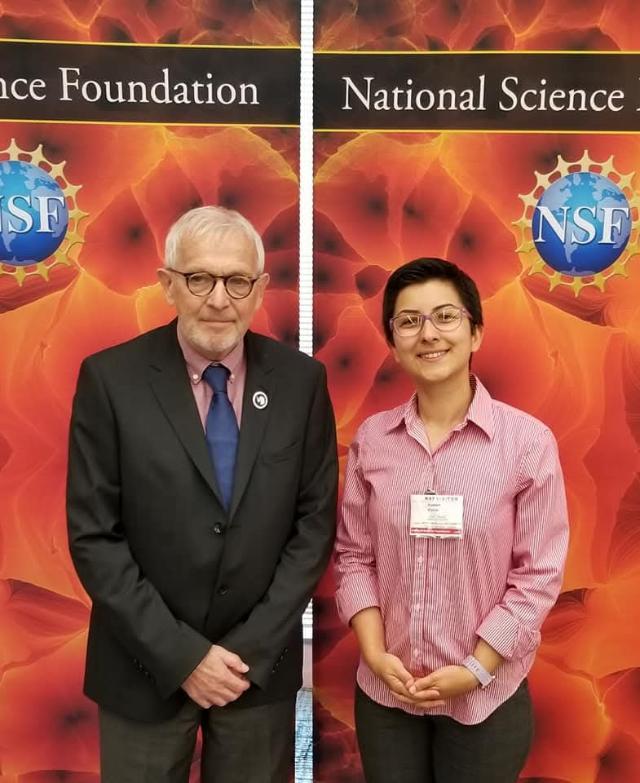
Physics Nobel Laureate Francis Halzen and Azadeh Keivani at a 2018 press conference announcing findings from IceCube Neutrino Observatory (photo courtesy of Azadeh Keivani)
October 6, 2026
Announced Oct. 6, the 2026 Nobel Prize in Physics and its laureate, Francis Halzen, have a special connection to two Lehman College faculty members whose work was based on data from the pioneering research facility Halzen established, the IceCube Neutrino Observatory. The observatory is a massive particle detector at the South Pole made of Antarctic ice, buried beneath the surface and extending to a depth of about 2,500 meters.
As a post-doctoral researcher in Physics, dean of the School of Continuing and Professional Studies Azadeh Keivani worked with Halzen on a major 2017 finding made through the observatory confirming that high-energy neutrinos may have an astrophysical source. These tiny, almost massless atomic particles rarely interact with matter and are difficult to detect.
“IceCube Neutrino Observatory opened up a new window to our universe, and for the discovery of high energy neutrinos of coming for outside our solar system,” said Keivani. “Now a new field of neutrino astronomy and multi messenger astronomy has been born thanks to Francis’s and IceCube’s work.”
Keivani was one of only two postdocs invited to a 2018 National Science Foundation press conference announcing the finding.
Recently, Physics professor and chair Luis Anchordoqui has been working with more recent IceCube data and co-authored a paper with Halzen last year positing the existence of tiny five-dimensional primordial black holes, evidenced by a high-energy neutrino detected more than a mile below the polar ice in 2022.
Read more about Francis Halzen and the Nobel Prize-winning research at IceCube observatory in the Swedish Royal Academy of Science's press release.