

Early Childhood Centers Day Care Centers
800 Concourse
Village East
Therman Statom
Luz (Light), 2001, Fiberglass, terrazzo, aluminium and glass
Architect: Castro-Blanco,
Piscioneri & Associates
Department of Design
and Construction
Agency for Child Development
Percent for Art Program
Architect: Castro-Blanco,
Piscioneri & Associates
Department of Design
and Construction
Agency for Child Development
Percent for Art Program
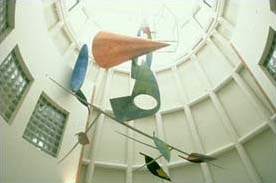
Located in the lobby of the Children's Pride Day Care Center (known as the Concourse Village East Day Care Center, when the piece was commissioned), Therman Statom's installation, Luz, consists of two parts: an expansive terrazzo floor and a huge metal and glass sculpture that hangs from the ceiling. The floor is inlaid with green-leaf shapes while the sculpture resembles a large-scale child's mobile, the elements of which include a fiberglass painted moon, a copper cone shape, metal painted leaves, and a clear glasshouse.
1810 Davidson Avenue
Noah Jemisin
Leaf Over My Shoulder
1998, two murals, four paintings and one sculpture
Agency for Child Development
Percent for Art Program
1998, two murals, four paintings and one sculpture
Agency for Child Development
Percent for Art Program
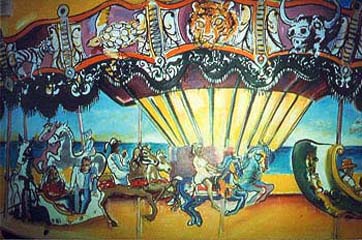
Seeking to inspire the young viewers at the Davidson Day Care Center to pursue and enjoy artistic expression, Noah Jemisin used familiar imagery such as this carousel as well as a style that emphasizes bold colors and a free line to connect with their creative energy and aesthetic values.
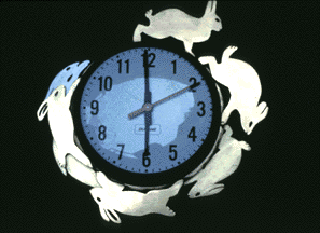
Christy Rupp's sculpture, Time Flies, explores the concept and relativity of time. The work consists of a series of sculptures encircling double-sided hall clocks. Constructed of bronze, brass, copper and aluminum, they include images of animals, such as rabbits, a turtle, a jaguar and an ammonite. Each figure represents a concept of time: for example, the jaguar symbolizes speed while the turtle signifies a slower pace. The animal figures are presented as pairs uniting the concepts of time passing slowly to time passing quickly. One form depicts a turtle with a clock implanted in its shell, while a group of rabbits, at one o' clock, start racing around the perimeter. Another form pairs a comet to an ammonite (a fossil), and a third, a jaguar with a bronze sloth under the frame of a clock.
Rupp's work at E.C.C. #2 also deals with the issue of how experiences of time are relative depending on the stage of life we are in. The concept for the Early Childhood Center is to integrate and combine a day care center with an elementary school so that the children may be enrolled as early as 18 months old and stay in the same environment up to 6th grade.
Rupp's work at E.C.C. #2 also deals with the issue of how experiences of time are relative depending on the stage of life we are in. The concept for the Early Childhood Center is to integrate and combine a day care center with an elementary school so that the children may be enrolled as early as 18 months old and stay in the same environment up to 6th grade.
Fulton Avenue and
147th Street
Steve Mayo
Pets, 1996
ceramic relief tiles
New York City Board of Education
Percent for Art Program
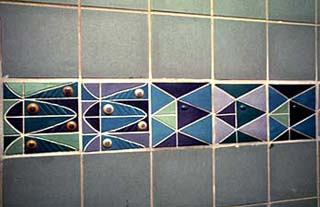
Steve Mayo's ceramic reliefs at the Early Childhood Center # 3 is a colorful frieze depicting bio- morphic shapes which change from abstract shapes into animal forms. Walking down the corridor, the students gradually experience the transition from shape to shape. The child can follow the ceramic "filmstrip" in an almost animated story, where fish turn to crocodiles and turtles turn into other reptiles.
Mount Hope Place
and Walton Avenue
Tom Nussbaum
Twelve Sculptures for ECC #4, 1997, bronze, painted
New York City Board of Education
Percent for Art Program
New York City Board of Education
Percent for Art Program
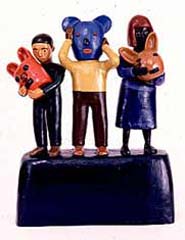
At the Early Childhood Center #4, there are twelve small sculptures by the artist Tom Nussbaum. Each sculpture is cast in bronze and painted in bright colors. Distributed throughout the school, they are displayed in an individual niche and positioned adjacent to a classroom door. Mounted at eye level, the works invite children to touch and explore them with their hands.
The sculptures also serve as location markers for classrooms within the school. They depict small groups of children, adults and animals in various situations with each suggesting small parts of a narrative. One sculpture depicts a bear reading to a little girl sitting on its lap; while another shows a boy reading to a lion. In still another children play with animal masks. More familiar scenes are depicted by other sculptural groups: a mother and child, a father with his son, and sisters and brothers. Nussbaum's whimsical works invite the students to cross the bridge between fantasy and reality.
The sculptures also serve as location markers for classrooms within the school. They depict small groups of children, adults and animals in various situations with each suggesting small parts of a narrative. One sculpture depicts a bear reading to a little girl sitting on its lap; while another shows a boy reading to a lion. In still another children play with animal masks. More familiar scenes are depicted by other sculptural groups: a mother and child, a father with his son, and sisters and brothers. Nussbaum's whimsical works invite the students to cross the bridge between fantasy and reality.